——The Power of TCM in Harmonizing Mind and Energy In the modern world of spiritual…
Seeing the Resilience of Life at Fibroscan 9.1 kPa: TCM Treatment for Alcoholic Cirrhosis
For many, the word “cirrhosis” on a medical report feels like an irreversible countdown. Especially when the Fibroscan (liver stiffness measurement) exceeds 20 kPa, reaching the F4 stage (cirrhosis), the medical consensus is often that it can only be managed, not reversed.
However, I have always believed that life possesses an inherent instinct to survive. As long as the path is correct, a home can be rebuilt even upon ruins. Today, I am sharing the case of a 62-year-old patient—a solid testament to this “rebirth.”
Sobriety: The First Step in Clearing the Ruins
Before finding me in 2022, the patient made the most courageous decision: to quit alcohol completely.
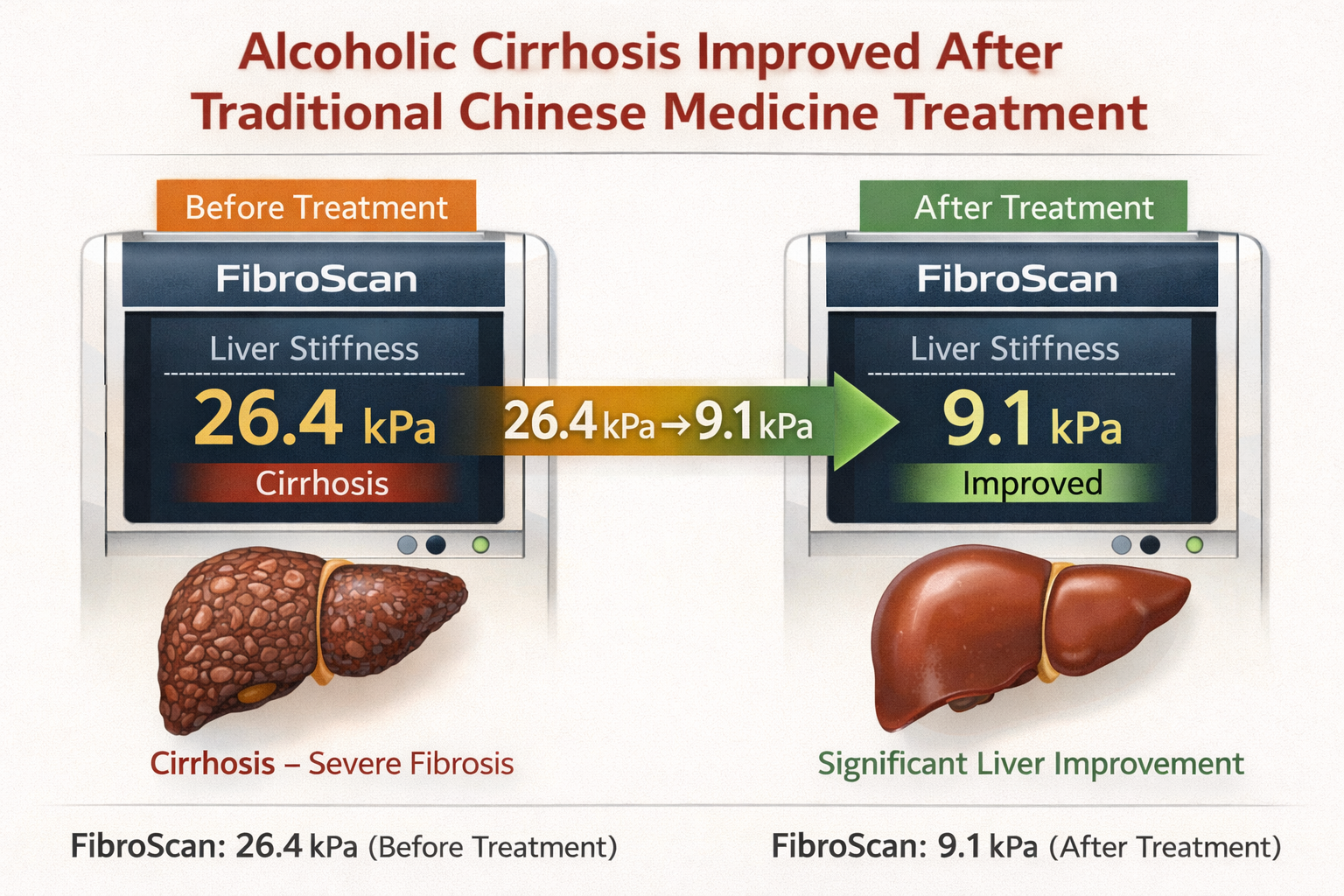
Sobriety alone brought his liver stiffness down from a staggering 72.4 kPa to 26.4 kPa. Medical research confirms that quitting alcohol significantly reduces liver inflammation, leading to a sharp drop from extreme highs. However, in clinical observation, improvements from sobriety alone often stall at a “plateau period” of 20-25 kPa. This is because the established fibrous septa and pseudolobules remain as “chronic scars” on the liver. It is akin to a massive fire being extinguished; while the flames no longer spread, the devastation remains. At that point, he still faced esophageal varices, ascites, numbness in both feet, and severe hormonal metabolic disorders.
Many ask: if sobriety already brought improvement, why pursue Traditional Chinese Medicine (TCM)?
Because “stopping the loss” is not the same as “repairing the damage.” 26.4 kPa is still the danger line for cirrhosis. Without deep intervention, the liver is like a piece of parched, withered wood, struggling to regain vitality on its own.
Three and a Half Years of Persistence: The “Golden Age” of Resolving Stasis and Generating the New
Starting in June 2022, we began a journey of TCM regulation lasting over three years. The diagnosis was: Liver Yin and Blood Deficiency, Blood Stasis obstructing the collaterals, and Liver Qi Stagnation.
My strategy was simple yet profound:
• Nourishing Yin and Blood: To water the parched liver, providing the “raw materials” needed for repair.
• Activating Blood and Resolving Stasis: To slowly dissolve the hardened fibrous tissues, much like clearing a blocked riverbed.
• Soothing the Liver and Regulating Qi: To improve the patient’s emotional state, for when Qi flows, blood follows.
The Moment of Final Judgment: Answers from the Data
As the TCM treatment progressed, the lab results gave us all a magnificent surprise:
• Stiffness Downgrade: The Fibroscan eventually dropped to 9.1 kPa. He officially regressed from F4 (cirrhosis) to F2 (significant fibrosis). This isn’t just improvement; it is a qualitative leap.
• Function Perfection: His INR reached a perfect 1.1, meaning his liver’s synthetic function is now identical to that of a healthy person.
• All Clear Indicators: Albumin at 4.6, Total Bilirubin at 0.6, and a marked improvement in Estradiol.
• Physical Miracle: The once-present esophageal varices and ascites completely disappeared. Under Western medical advice, the patient ceased Propranolol in December 2022 and Lisinopril in April 2023.
A Physician’s Reflection: Practice is the Sole Criterion for Testing Truth
This case reaffirms my conviction: the charm of TCM lies not in mysterious theories, but in its tangible ability to change physical indicators. The extraordinary nature of this case lies in the fact that after six months of sobriety, when the values had reached a plateau (26.4 kPa), three and a half years of TCM “resolving stasis and generating new tissue” treatment allowed the stiffness to break through once again, finally reaching 9.1 kPa. This inverse leap from “cirrhosis” to “significant fibrosis” is not merely the subsidence of inflammation, but a physical remodeling of the liver’s microscopic structure. This proves the irreplaceable role of TCM in the “repair and restoration” phase.
If you find yourself in a similar predicament, remember: Do not fantasize; instead, practice. First, have the courage to sever the cause of the disease (such as quitting alcohol); second, give your body time and use the correct medicinal path to awaken it. As long as Yin and Yang reach a balance, life will always surprise you.
Conclusion
I am deeply grateful to my patient. His extraordinary self-discipline and trust in TCM were the true catalysts in this three-and-a-half-year journey from 26.4 kPa to 9.1 kPa. This is not just a medical record; it is a witness to the resilience of life.

Related Posts